Safe buying guide
When buying a safe, there are many important factors to consider—from insurance classification to proper anchoring. Our guide will help you find the right safe for your needs.
Insurable and non-insurable safes
Safes are divided into different security levels or insurance classes. These determine the maximum amount that valuables will be replaced by the insurance company in the event of damage.
Important: Before you buy a safe, you should contact your insurance company. They will tell you which insurance class is required for your protection.
Insurance classes for safes in Austria
Security classes are tested and certified in accordance with EN 1143-1 (security cabinets) or EN 14450 (security cabinets). The higher the class, the better the burglary protection.
| Security level | Insurance sum private | Commercial insurance sum |
|---|---|---|
S1 (EN 14450) | up to approx. €2,500 | No classification |
S2 (EN 14450) | up to approx. €20,000 | No classification |
Grade N / 0 (EN 1143-1) | up to approx. €40,000 | up to approx. €10,000 |
Grade 1 (EN 1143-1) | up to approx. €65,000 | up to approx. €20,000 |
Grade 2 (EN 1143-1) | up to approx. €100,000 | up to approx. €50,000 |
Grade 3 (EN 1143-1) | up to approx. €200,000 | up to approx. €100,000 |
Grade 4 (EN 1143-1) | up to approx. €400,000 | up to approx. €150,000 |
Grade 5 (EN 1143-1) | up to approx. €500,000 | up to approx. €250,000 |
Grade 6 (EN 1143-1) | up to approx. €750,000 | up to approx. €375,000 |
Note: Actual insurance sums may vary depending on the insurance provider!
Why are insurance classes so important?
Regulates insurance coverage: The classification determines whether and to what extent your safe can be insured. What is insured will be replaced in the event of burglary or fire, depending on the policy!
Guarantee of quality and security: Certified safes are tested by independent institutes.
Labeling of certified safes
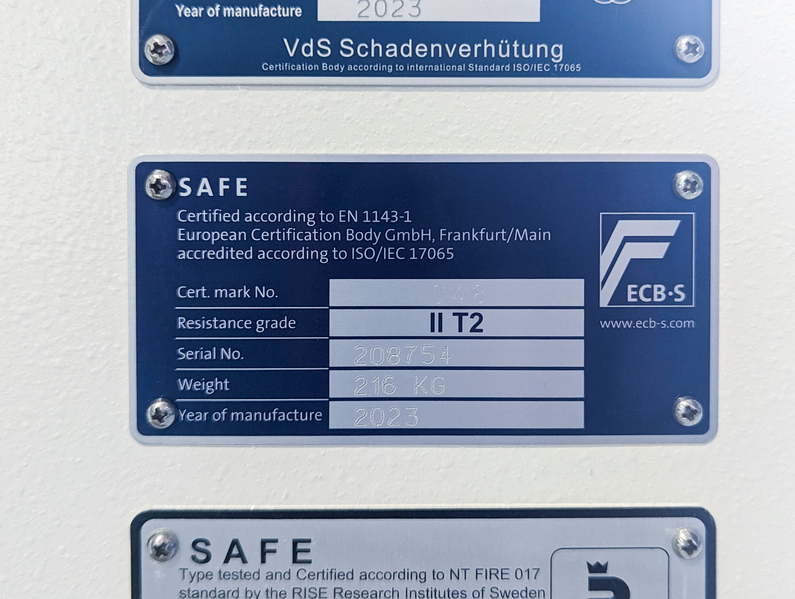
Each tested safe receives a security label inside the safe (usually on the inside of the door). This label contains:
Security level (EN 1143-1 or EN 14450)
Testing institute (e.g., ECB-S, VdS)
Serial number & manufacturer information
Without this label, the safe is not certified and may not be recognized by insurance companies!
Choosing the right type of safe:
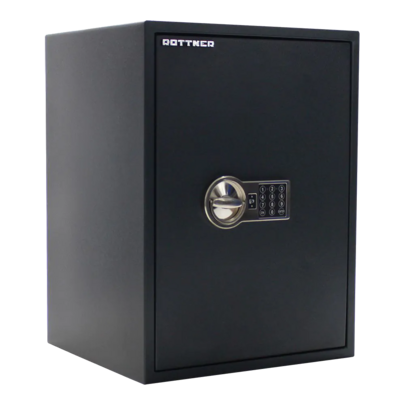
Furniture safes – Compact security for home and office
Furniture safes are the ideal solution for storing valuables, documents, and cash discreetly and securely. They are compact, easy to install, and can be integrated inconspicuously into cabinets or furniture.
Advantages of furniture safes:
Space-saving & inconspicuous – Easy to integrate into furniture
Burglary protection – models with security levels according to EN 14450 available
Easy to install – Can also be anchored to the furniture
Security cabinets – Maximum security for valuables and documents
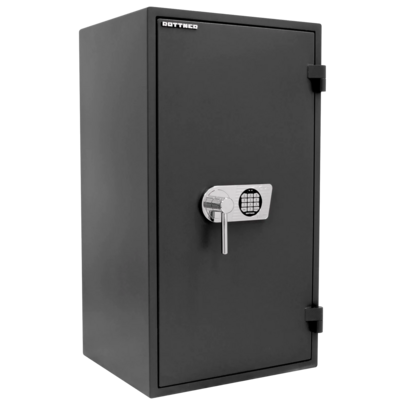
Security cabinets are solid, certified safes that offer maximum protection against burglary and fire. They are available in various security classes (EN 1143-1) and are therefore insurable.
Why choose a security cabinet?
Maximum security – Certified according to EN 1143-1 with various security levels
Insurable – Insurance sums of up to several hundred thousand euros
Solid construction – With double-walled construction and special filling to prevent break-in attempts
Fire protection: Many models also offer fire resistance in accordance with EN 1047-1 or LFS 30P/60P or even 120P (fire protection for paper documents).
Tip: Uncertified furniture safes offer protection against unauthorized access but are not insurable. If you want insurance coverage, choose a model with security class EN1 or higher.
Wall safes – invisible protection for valuables
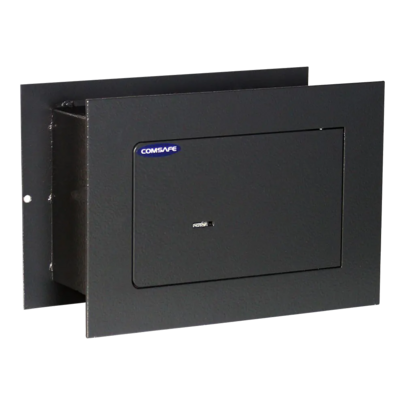
Wall safes are built into the wall and offer particularly discreet protection. Once installed, they are almost invisible and can be perfectly concealed behind pictures or furniture.
Advantages of wall safes:
Space-saving & invisible – Perfectly integrated into the wall
Greater security – Only the front remains accessible
Firm anchoring – Mounted directly in the masonry
Important note: A wall safe must be installed in solid masonry (e.g., concrete or brick). Lightweight walls or plasterboard walls are not suitable!
Tip: Plan for the wall safe when building a new home or renovating, as retrofitting is costly.
Gun cabinets – Legal storage of firearms
In Austria, firearms are subject to strict storage requirements. Gun cabinets are specially designed to secure weapons and ammunition in accordance with the law.
What security level do I need?
In Austria, there are no legally defined security levels for gun cabinets, as is the case in Germany.
Important features of gun cabinets:
With gun holders and interior dividers for optimal organization
Double-walled construction for increased protection
Tip: Always check the legal requirements before purchasing a gun cabinet, as these are subject to change!
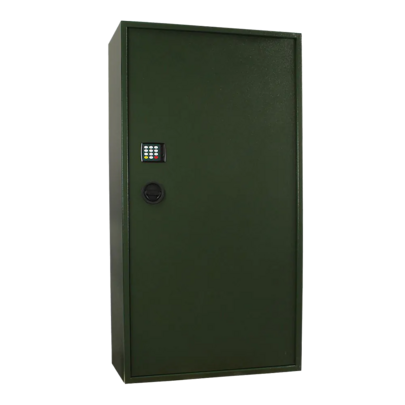
Data protection cabinets – Secure protection for data carriers & NIS2-compliant solutions
In times of increasing cyber and data security requirements, the physical protection of sensitive data is also becoming increasingly important. Data protection cabinets offer certified burglary and fire protection for digital media such as hard drives, USB sticks, magnetic tapes, or external server backups.
Why data protection cabinets are indispensable for companies
Protection against fire and heat – Certified according to EN 1047-1 or LFS 60D/120D, protecting data carriers from heat for up to 60 or 120 minutes
Water protection – Many models offer protection against firefighting water and high humidity
Burglary resistance – Certified according to EN 1143-1 for additional theft protection
NIS2-Ready? – Data protection cabinets such as the Format Fire Star Plus could meet future NIS2 guidelines
What does NIS2 mean?
The EU's NIS2 (Network and Information Security 2) directive aims to improve the protection of critical infrastructure and sensitive data. Companies must therefore demonstrate not only digital security measures, but also physical protection measures for their backups and data carriers.
Tip: Those who opt for a NIS2-compliant data protection cabinet at an early stage can more easily meet legal requirements and avoid expensive retrofits.
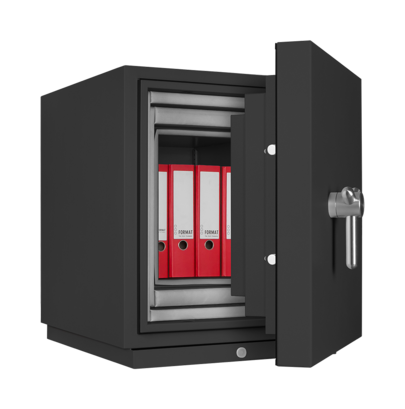
Key safes – Secure storage for keys
A key safe protects important keys from theft or unauthorized access – ideal for businesses, car dealerships, property management companies, or hotels.
What types of key safes are available?
Small key safes for private use or individual keys
Large key safes with hook strips for professional use
Electronic key cabinets with access control
Advantages of a key safe:
Protects against loss or theft
Secure management of multiple keys
Electronic models with logging for businesses
Tip: Insurance requirements for key safes may apply in commercial areas – check with your insurance company in advance!
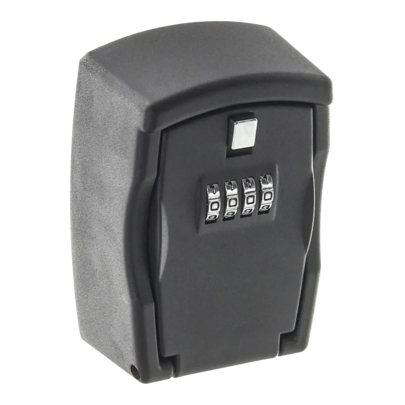
Weight – An important safety factor
Rule of thumb: The heavier the safe, the more difficult it is to steal. An unsecured 150 kg safe can easily be stolen using a trolley.
Anchoring – mandatory for insurance purposes
Safes weighing less than 1000 kg must be anchored in order to be recognized by insurance companies.
Please note: Safes may only be anchored in solid masonry (e.g., concrete or brick)!
Plasterboard or lightweight walls do not provide a secure hold and are not recognized as compliant anchoring.
Before purchasing, you should clarify the following points:
Is there underfloor heating that prevents floor anchoring?
Is the wall made of solid concrete or brick, or is it just a thin partition wall?
Knock test – a simple quality check
Tip: Knock on the safe! A dull sound indicates a solid construction. A bright, hollow sound indicates thin-walled models.
Our safe brands – Highest quality & security
Wide selection of furniture safes and gun cabinets with fast delivery times.

Premium safes from Austria with the highest security standards.
Specialist in security and commercial safes.
Reliable quality for private and commercial use.